The Mind of the Holocaust Perpetrator in Fiction and Nonfiction by Erin McGlothlin
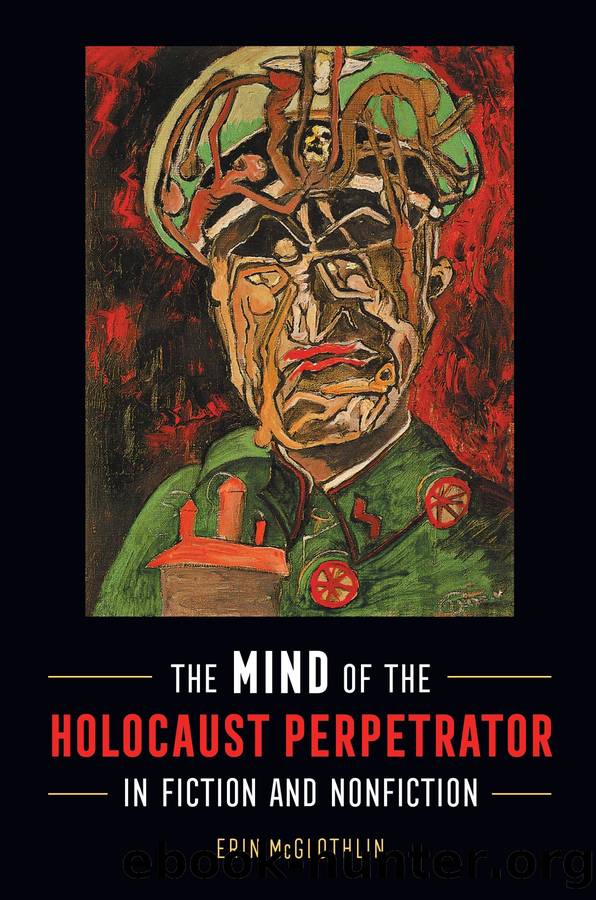
Author:Erin McGlothlin [McGlothlin, Erin]
Language: eng
Format: epub
Tags: LIT024000 Literary Criticism / Modern / General, LIT025010 Literary Criticism / Subjects & Themes / Historical Events, HIS043000 History / Holocaust
Publisher: Wayne State University Press
Published: 2021-05-04T00:00:00+00:00
12 It is important to note, however, that Todorovâs typology is a separate issue from the narratological distinction I make above between the diegesis of the interview and Serenyâs extradiegetic commentary in the role of narrator. My classification according to diegetic level is a structural one that focuses on the interview scene as the primary narrative and Serenyâs reflections on that scene as a secondary one. Todorovâs framework, on the other hand, helps to distinguish between the principal story of Stanglâs crimes and the second-level story of Serenyâs attempt to uncover the meaning of these crimes. As Peter Hühn helpfully elaborates on Todorovâs model, âThe plot of the classical detective novel comprises two basically separate storiesâthe story of the crime (which consists of action) and the story of the investigation (which is concerned with knowledge). In their narrative presentation, however, the two stories are intertwined. The first story (the crime) happened in the past and isâinsofar as it is hiddenâabsent from the present; the second story (the investigation) happens in the present and consists of uncovering the first story. . . . Employing Gérard Genetteâs and Seymour Chatmanâs distinction between story and discourse, one can define the narrative organization of a classical detective novel as follows. The usual constellation of story and discourse (the abstractable preexistent sequence of events and acts versus its mediation in a narrative) occurs twice over: the story of the crime is mediated in the discourse of the detectiveâs investigation; and the story of the detectiveâs investigation, in its turn, is mediated in the narratorâs discourseâ (452). Hühnâs last definition of the structure of the classical detective novel according to the doubled functions of story and discourse seems to me to be the closest approximate to the organization of Serenyâs book.
Download
This site does not store any files on its server. We only index and link to content provided by other sites. Please contact the content providers to delete copyright contents if any and email us, we'll remove relevant links or contents immediately.
The Fine Print (Dreamland Billionaires Book 1) by Lauren Asher(2546)
Fury of Magnus by Graham McNeill(2435)
The Last House on Needless Street by Catriona Ward(2380)
The Rose Code by Kate Quinn(2187)
A Little Life: A Novel by Hanya Yanagihara(2092)
Malibu Rising by Taylor Jenkins Reid(1902)
The God of the Woods by Liz Moore(1892)
Luster by Raven Leilani(1890)
Transcendent Kingdom by Yaa Gyasi(1843)
Moonflower Murders by Anthony Horowitz(1833)
The Lost Book of the White (The Eldest Curses) by Cassandra Clare & Wesley Chu(1678)
This Changes Everything by Unknown(1495)
The Midwife Murders by James Patterson & Richard Dilallo(1471)
The New Wilderness by Diane Cook(1434)
The Lying Life of Adults by Elena Ferrante(1424)
Wandering in Strange Lands by Morgan Jerkins(1406)
Written in the Stars by Alexandria Bellefleur(1390)
Ambition and Desire: The Dangerous Life of Josephine Bonaparte by Kate Williams(1379)
The Lying Life of Adults by Elena Ferrante;(1301)
